There is a lot of excitement brewing regarding new technology that promises to make LED municipal applications, like streetlights, much more efficient and cost-saving than ever before. The key to this phenomena is recent Red Phosphor research that shows how to improve and increase the impact of LED outdoor lighting, such as LED roadway lighting and streetlights, which can potentially save towns, counties, and municipalities countless dollars.
Wondering why now is the time for LED retrofits? Consider the latest LED technology:
Recent LED Revelations An engineering team in Innsbruck, Austria, recently studied how to make LED lighting more efficient, and subsequently, cost-effective in municipal applications. What they discovered was a new high-performing red phosphor that increases light emissions in an unexpected way. The result in a longer-lasting, brighter illumination.
A New Phosphor In layman’s terms, this new phosphor dubbed ‘SALON’ successfully and slightly shifts light emissions toward a blue hue from a more- red light. IT has good thermal stability and combines spectral positions for better spectral width. What this does is increase the energy efficiency of the white-emitting phosphorous converted LEDs; confused? Don’t be; what this boils down to is greater efficiency and reduced cost of utility over time- the perfect lighting solutions for municipal uses, like streetlights, parking lots, and roadway lights.
The Future of LED Imagine now the impact and potential of Decorative LED street lighting using this new phosphor- the options could be limitless! Now is a great time to find out more about saving money with LED retrofits and changing-over your lighting fixtures and features to higher-tech LED lighting solutions.
Whether you know what phosphors are or not, you can appreciate how switching to LED can cut down on anyone’s bottom line, from a city’s public works budget to the homeowner trying to save money on their light bulbs and utility costs.
Looking for some relief on your electricity bill? Outfitting your yard or garden with solar-powered lights is a good way to save some cash. Not only that, they are a great way to boost the curb appeal of your property. The best outdoor solar lights also don’t compromise on power or beauty. They’re environmentally friendly and easy to maintain. Outdoor solar lights are weatherproof and turn on and off automatically based on sunlight.
Best Outdoor Solar Lights
1. Moonrays Solar Hanging Floral Stained Glass Light
Give your backyard an artistic bump with these decorative solar lamps. They’re made from metal, glass, and plastic, and provide 360 degrees of illumination. Each side features a hand-painted garden design on stained glass. They have a 24-inch above-ground height and will provide eight hours of light on a full charge.
2. Moonrays Payton Solar LED Plastic Path Light
These path lights are made from sturdy plastic with a “hammered” lens that gives style and shape to the light. At nearly 16 inches in height, the light won’t be obstructed by grass or shrub. The device is also weatherproof.
Installation is simple—just push the stake into the ground—and the light automatically turns on at dusk. It should last eight hours on a full charge. The solar panel is on top of the lamp, so it needs to be in direct sunlight during the day. They come in a pack of eight, making them good value for money.
3. InnoGear Solar Spotlight
You get two bright spotlights in this package, which is perfect if you want to highlight something in your garden or yard. They can be stuck into the ground or mounted on a wall. They turn on and off automatically at sundown and sunrise and have two brightness modes. Both the light and panel are adjustable, so you can shine it at the right angle while giving it the most sun exposure. These are well built and resistant to both water and heat.
4. Sunix Outdoor Solar Light with Motion Sensor
This spotlight, sold as a single, is a great choice for lighting up dark doorway areas, patios, stairways, over a garage, or around a car port. It can be mounted on a wall with the two included screws. This particular solar unit constantly emits a dim light in the evening and when it is completely dark. Furthermore, it provides a stronger light that is activated through motion detection (up to 20 feet away). By only emitting bright light when needed, it more efficiently uses the stored solar energy. It is a great middle ground between a dim light that’s on all of the time and a motion detection solar light that only comes on when someone triggers it.
5. Deneve Solar Flag Pole Light
Did you know the U.S. Flag Code suggests the American flag be lit up at night? This gives you two options: take down your flag every day before sundown, or buy a light to shine on it at night. An easy solar option is this light by Deneve. It sits atop your flag pole and automatically casts a light down on your flag when the time is right. The easy-to-set-up light is ideal for poles 15-25 feet in length.
Benefits of Using Outdoor Solar Lights
Once they’re set up, you won’t need to think about them again. Solar panels absorb sunlight and recharge the built-in batteries each day. When the sun goes down, the batteries power bright LED lights that can shine on your property all night long. All you need to worry about is making sure the panels are positioned to get the most sun.
With so many options available, finding solar lights that match perfectly with the outside of your home is easy. Set-up is also simple. Many lights come with the necessary pieces in order to install them yourself. What’s more, unless the solar panels are separate from the light fixtures, there’s no need for wires. It’s less of a hassle and more safe.
Still not convinced? Here are more benefits to using solar power:
It’s pollution-free and emits no greenhouse gases
Reduces dependence on oil and fossil fuels
Renewable clean power available every day, even when cloudy
Works even during a power outage
Can be installed anywhere, either in the ground or on a building
Taking care of the environment is a responsibility that everyone should feel accountable for. Most of us are already aware of environmentally friendly processes such as recycling to minimize the amount of waste we produce and reduce our carbon footprint. However, a lot of people are unaware of new and upcoming technologies that we can use to help reduce carbon emissions. A good example of this is LED lighting, which provides many environmental advantages. and LED s come for many purpose like if you want industrial led lighting.
Energy Efficient
LED lights are up to 80% more efficient than traditional lighting such as fluorescent and incandescent lights. 95% of the energy in LED’s is converted into light and only 5% is wasted as heat. This is compared to fluorescent lights which convert 95% of energy to heat and only 5% into light! LED lights also draw much less power than traditional lighting no matter if you are using commercial led light bulbs or industrial led lighting a typical 84 watt fluorescent can be replaced by a 36 watt LED to give the same level of light. Less energy use reduces the demand from power plants and decreases greenhouse gas emissions.
No Toxic Elements
LED lights contain no toxic elements. Most offices currently use fluorescent strip lights which contain noxious chemicals such as mercury. This will contaminate the environment when disposed of in landfill waste. Disposal has to be arranged through a registered waste carrier so switching to LED avoids the cost and time implications required for compliant disposal – and helps to protect the environment from further toxic waste.
Less Lights Needed
LEDs have a better quality of light distribution and focus light in one direction as opposed to other types of lighting which waste energy by emitting light in all directions, often illuminating areas where light isn’t required (such as the ceiling). This means that less LED lights are needed to achieve the same level of brightness given off by fluorescents and incandescent lights. Fewer lights will reduce energy consumption and will therefore be a benefit to the environment.
Life span
A longer life span means lower carbon emissions. LED Lights last up to six times longer than other types of lights, reducing the requirement for frequent replacements. This results in using fewer lights and hence fewer resources are needed for manufacturing processes, packaging materials and transportation.
Author: Alex Connell, Public Relations Officer at LED LightSense. Alex builds a good reputation for the organisation and manages its relationship with the public. He is also a writer promoting the environmental and performance benefits of LED lights.
Experts project that by 2050, 68% of the world’s population will be in living in urban areas compared to 54% in 2016. The rapid urbanization has had its fair share of challenges including but not limited to:
Increased pressure on transport systems and the cities’ infrastructure
Increased criminal activity and street violence
Challenges in water supply and sanitation
Overcrowding
This explains the increased adoption of the internet of things (IoT) to make smart cities and therefore, improve public safety, traffic monitoring, and improved environmental quality.
According to statistics, modern cities consume more than 70% of the globe’s energy supply, and as the urban dwellers increase, so will this figure. The only viable solution to this challenge is the implementation of smart lighting solutions.
Smart street lighting improves a city’s energy efficiency by cutting down on energy and maintenance costs, not to mention that they reduce carbon dioxide emissions. Smart LED lights automatically dim if there are no vehicles or pedestrians on the roads leading to a significant reduction in energy usage. Case in point is the implementation of LED street lighting in California helped the government save more than 61.2 million kilowatt-hours, which translated to about $9 million.
Smart street lighting goes beyond energy consumption and environmental sustainability
Smart street lighting provides an ideal network where other IoT applications and devices can be connected, thus accelerating the growth of smart cities. As they are ubiquitous data can be collected and relayed to interconnected devices for services such as smart parking, traffic control, environmental monitoring, mobile broadband, and Wi-Fi connectivity, and public safety.
Real-time monitoring of street light through smart technology allows for immediate intervention should any have electrical problems or malfunction.
Multiple municipal departments optimize the data and analytics provided by data collected by smart devices and applications to improve operational efficiencies. This improves the residents’ quality of life and creates jobs. Cities are using decorative LED street lighting to highlight key city features such as parks, footpaths, bicycle tracks, and monuments, among others. Decorative street lamps provide aesthetic appeal while delivering LED benefits.
Each city is unique, defined not only by the individuals who call it home but also by the energy it exudes…and consumes. Projections indicate that 5 billion people (60% of the world’s population) will live in cities by 2050 and, according to the International Energy Agency, the overall demand for lighting will be 80% higher by 2030 than in 2005. Street lighting energy consumption is an increasingly significant part of cities energy use and a growing burden on municipal budgets.
So, how can cities maintain this (growing) asset?
Many cities around the world are implementing public lighting programs for two main reasons –economic growth and community safety. Public lighting supports economic growth by increasing the amount of time that people can spend on dining and entertainment after dark. At the same time, studies have shown that public lighting can reduce crime by up to 20% and traffic accidents by up to 35%.
LED lighting benefits the environment and local authority budgets alike. LED lights are 40 to 60% more energy efficient than traditional lighting technologies. Simply by using LED luminaries, it is possible to provide better quality lighting, lower energy consumption, and reduce CO2 emissions. In the United States alone, replacing outdoor lighting with LED lighting can save US$6 billion annually and reduce carbon emissions by the equivalent of taking8.5 million cars off the roads for a year. Operations and maintenance (O&M) costs also tend to be much lower because LED luminaires last at least four times longer than traditional bulbs. The cost savings can help ease the financial burden of municipalities that have tight fiscal budgets and are burdened by heavy utility bills. For example, in Quezon City, Philippines, street lighting constituted 65% of the city’s electricity costs and 5% of its overall budget. In India, street lighting electricity and maintenance costs can consume 5 to 10% of municipal budgets in large cities and up to 20% in smaller cities. Cities that invest in LED street lighting can then take the savings and invest in other services, such as sanitation, schools, or public health.
However, financial barriers and institutional constraints prevent many municipal cities from picking this “low-hanging fruit.” While the energy and cost savings potential of LED public lighting far outweigh the initial investment and physical retrofitting is relatively uncomplicated, the capital costs are still higher than those of traditional technologies. Unsubsidized LED luminaires can cost two to four times more than high-pressure sodium-vapor (HPS) luminaires, depending on taxes, exchange rates, the absence or presence of local manufacturing, and the size of the LED program. Capital investments can be too high for city governments that have few resources to deploy. Many municipalities in developing countries either lack the credit to raise money on the market, or the cost would be so high that the viability of the lighting program would be reduced dramatically. In addition, cities may face challenges including perception barriers, lack of a supportive regulatory environment, and low institutional capacity to develop and manage complicated business models.
Embarking on such projects can be daunting and confusing as how to effectively implement a LED street lighting projects. To better inform future project design and facilitate scaling-up of efficient street lighting, the World Bank’s Energy Sector Management Assistance Program (ESMAP) and Social, Urban, Rural, and Resilience Global Practice (GSURR) jointly published a synthesis report, Proven Delivery Models for LED Public Lighting, and six case studies that highlight successful delivery models for LED street lighting:
Flexible Joint Procurement (Canada). Multiple cities across Ontario came together to procure LED lighting jointly to reduce costs—illustrating that small municipalities can jointly procure LED public lighting with the help of a strong regional association.
Super-ESCO (India). The Ministry of Power set up a super energy service company (super-ESCO) that transformed the LED market in India by lowering LED costs through its bulk procurement program and setting standards for ESCO procurement.
Private ESCO (India). One way to overcome the high up-front costs of implementing efficient public lighting is to leverage private funding and repay it through long-term energy savings. Asian Electronics Limited (AEL) applied this energy service company model in Central and Northwestern India.
Lease-to-Own (Mexico). The municipality of Guadalajara, Mexico, introduced LED public lighting through a lease-to-own delivery model, with private company financing, a repayment guarantee from the state government, and technical assistance by the World Bank to help address the bureaucratic challenges.
Municipal Financing (Philippines). Quezon, Philippines, used its own resources to finance the investment in LED lighting, thus cutting its high expenditure on public lighting.
Public-Private Partnership (PPP) or “Bundle-to-Save” (United Kingdom). To reduce the transaction cost, the PPP model in Birmingham combines several infrastructure investments—including roads, streets, and bridges in addition to lighting—under one PPP contract.
LED street lighting remains one of the most visible energy efficiency projects a city can undertake that benefits the entire community.
Whether romantic, relaxing, or a party vibe, outdoor decorative lights can create a certain ambience.
Set the mood and add beauty to your pergola without spending more on your electricity bill by getting solar powered lights.
With that said, let’s get right to it.
Here’s a list of the best solar LED pergola string lights and their reviews for 2019.
1. Brightech Ambience Pro LED Waterproof Outdoor String Lights
With 2,578 5 star reviews on Amazon, you can’t go wrong with these lights! They are bright enough to cook out, yet not overwhelming. They give off a classy industrial vibe with the open light bulbs.
These come in either a 24-foot strand or 48-foot strand. The bulbs are spaced three feet apart.
Pros & Benefits:
Heavy duty – can withstand winds of up to 50 mph
Waterproof
Energy saving
3-year warranty
2. Enbrighten Classic LED Cafe String Lights
These lights give off a romantic feel with the black acrylic finish and classic light bulbs. The Enbrighten Classic lights are advertised as virtually indestructible – the bulbs will not break if they are stepped on, fall, or blown around in wind or rain as the bulbs are thick.
They come in options of 12, 18, 24, 36, or 48 feet. There is a 24-inch spacing between each bulb. These lights can be installed on flat surface or hung from above.
Pros & Benefits:
Easy to install
Energy efficient
Can be linked up to 750 feet
Lifetime warranty
3. Lampat Globe String Lights
If you’re looking for warm light to see around your pergola, but still want that gentle romantic glow, these are the lights for you.
These are 25 feet long with 12 inch spacing between round G40 bulbs. Unlike traditional decorative string lights, if one bulb is removed or breaks, the remaining bulbs continue to light up. You can attach three more strands.
Pros & Benefits
Bulbs don’t get hot after hours of use
100% satisfaction guarantee with 1 year quality guarantee
Comes with extra bulbs if needed
4. MAGGIFT Hanging Retro Solar Lantern
If you’re looking for a more vintage, magical feel, these lights are perfect. They give off a warm amber color, unlike many solar lights that have cool undertones. The round, white iron displays a beautiful pattern of light. They come in a pack of two and measure 6 x 6 x 6.7 inches.
Pros & Benefits:
Can last 8 or more hours or more at night
Can be hung by the ring or placed on a table top
180-day product warranty
5. Kyson Solar Powered LED Light
This is a small, stainless steel, industrial style light with a black finish. It has a remote control that can operate from up to five meters away and a two-foot pull cord, adding versatility of where to place it.
The dimensions are as follows: 16 x 7cm and the solar panel is 9.8 x 8.5cm. It takes between six and eight hours to charge and stays lit for ten to twelve hours. The package includes one solar LED light. The cord length is 10-12 feet long.
Pros & Benefits:
Intense lighting
Shock and vibration resistant
Batteries included
Waterproof
Final Thoughts
Solar lights are a great option to brighten your outdoor pergola space and shrubs and gardens surrounding it, without your electricity bill going through the roof.
Whether you are looking to create a romantic, intimate setting; a party vibe, or just light up your outdoor area, this list of solar lights are sure to suit your preferences.
We hope you enjoyed this list of the bestsolar powered lights and their reviews in 2019. See something that’s not on this list and should be? Let us know in the comments below.
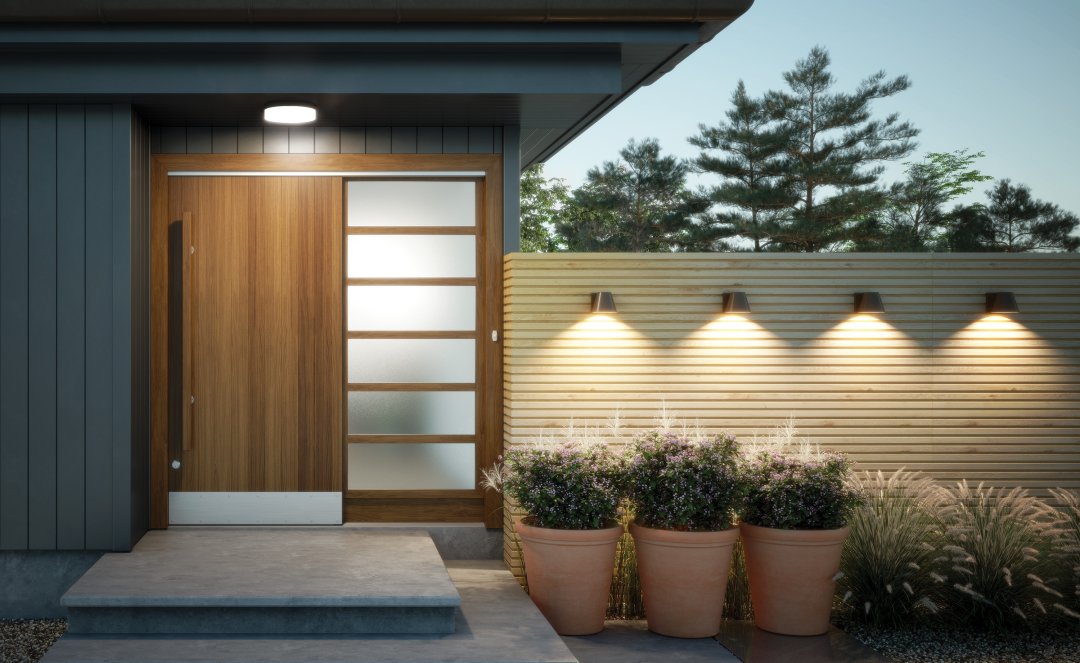
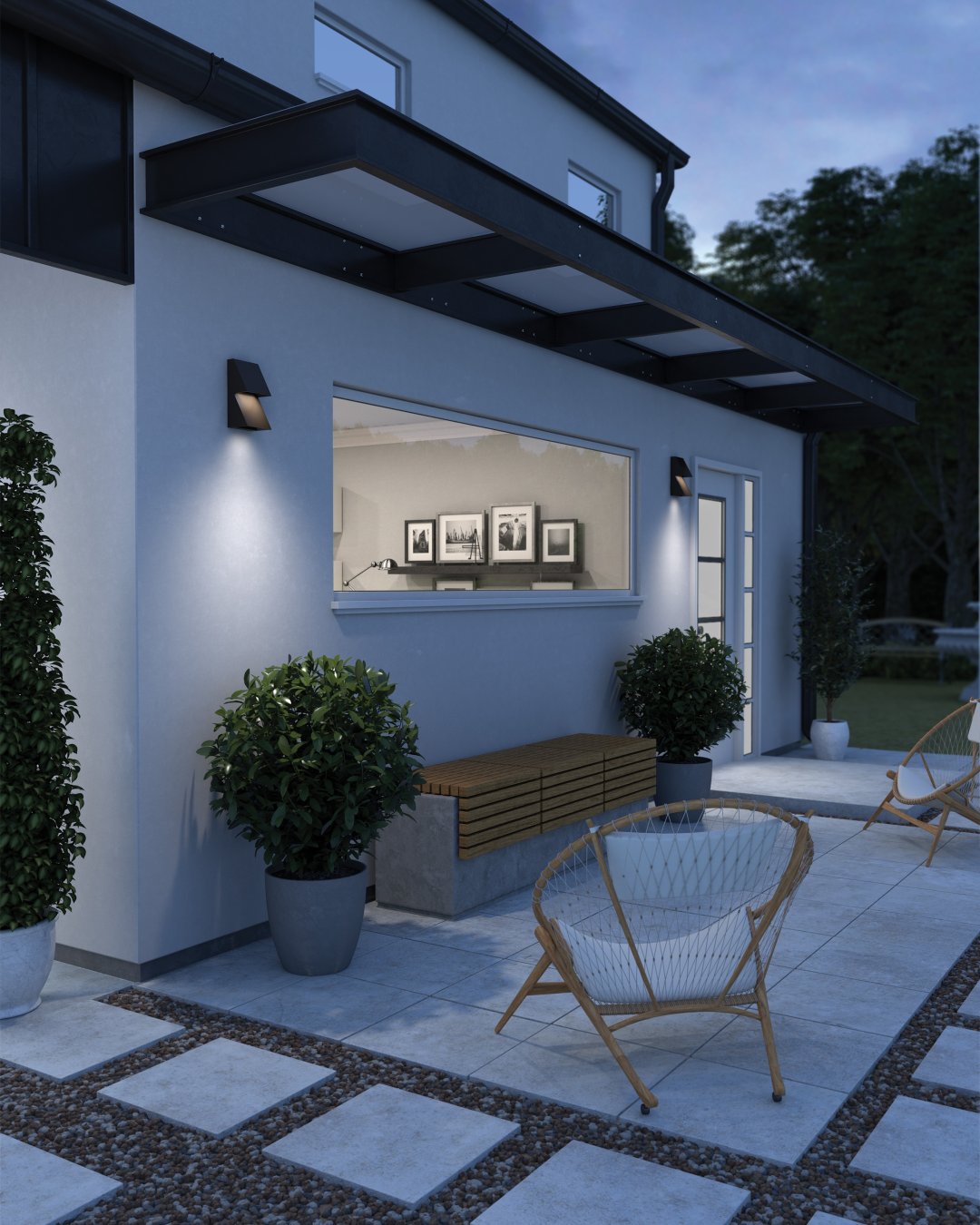
Whether you own a single-family home, townhouse or condominium, you should give outdoor lighting the same consideration as your indoor lighting. After all, exterior lighting has so many benefits. It:
Provides increased safety after dark. In addition to making it easier to maneuver around the outside of your home, it helps to thwart crime.
Enables way finding (seeing how to get from one location to another).
Creates a warm welcome when family and guests enter the front door.
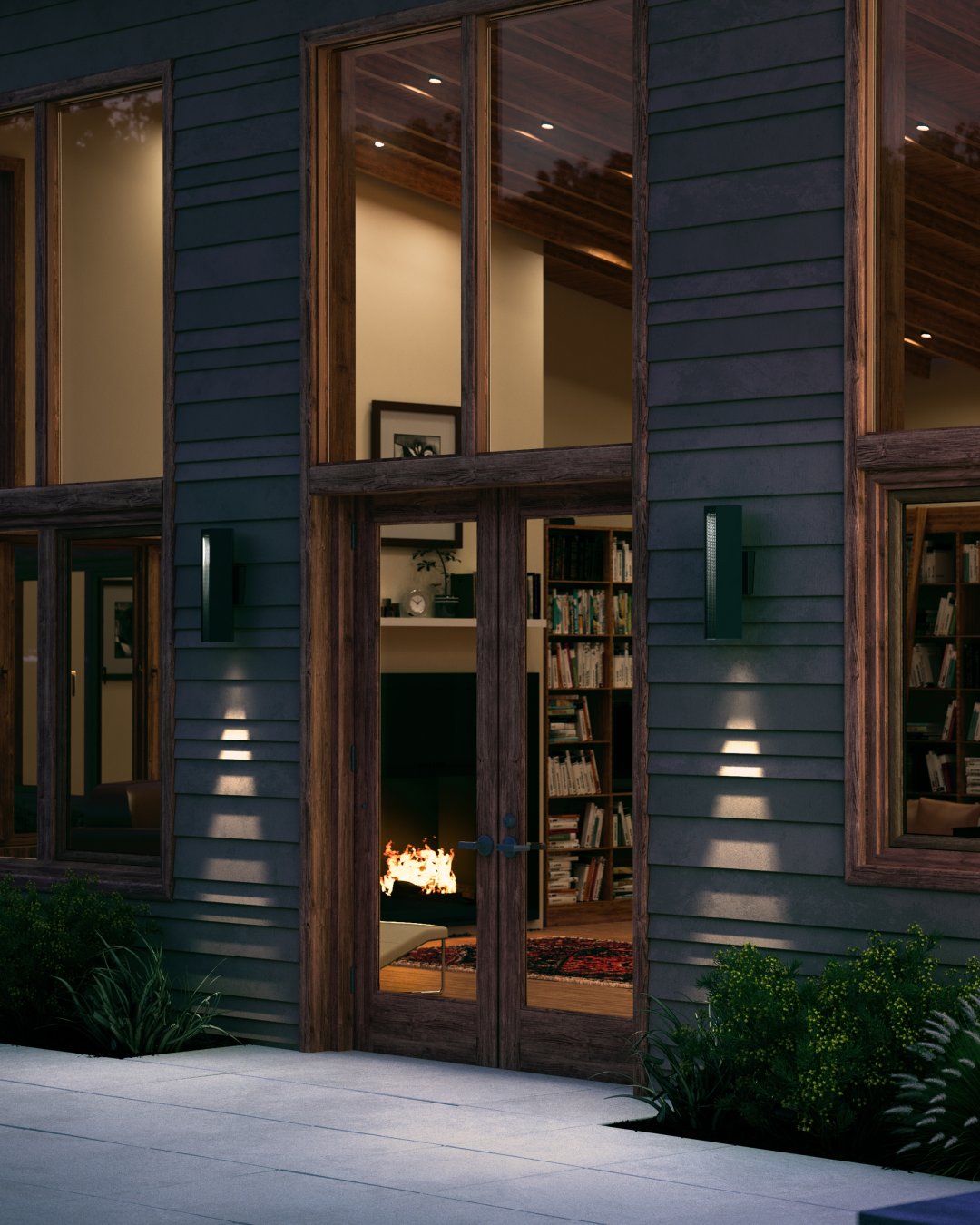
Highlights and adds drama to interesting landscape or architectural features.
Helps to create comfortable and communal surroundings, such as a defined seating or entertainment area.
Enables outdoor grilling at night—particularly useful during seasons when it gets darker earlier.
Increases curb appeal—not only while you live in your home, but when you decide to sell.
But these benefits aren’t givens just through the mere presence of outdoor lighting. To make the most of them, your outdoor lighting scheme needs to be carefully considered and executed.
Aim for a Balance of Security and Aesthetics
A good beginning is to simply walk around your home at night with a flashlight. Take note of dark areas that should be lit for safety and landscape, or garden areas that could be lit for additional interest or beauty. Just like indoor lighting, think about the types of light–ambient (general lighting), task (helps you perform specific tasks, such as preparing and cooking food), and accent (to highlight and add drama to architectural or landscape features).
Don’t forget specific areas that could benefit from lighting, such as the front door, a pool, steps, driveways, garage doors, pathways, decks or patios, address plates, landscaping, flagpoles and outdoor cooking areas. While you’re assessing where you need light, also assess beam angles. Direct lighting isn’t always the best, as you don’t want it where it can glare in people’s eyes; you may find diffused or ambient light is the better route.
Decide What Fixtures Will Work Best for Your Outdoor Space
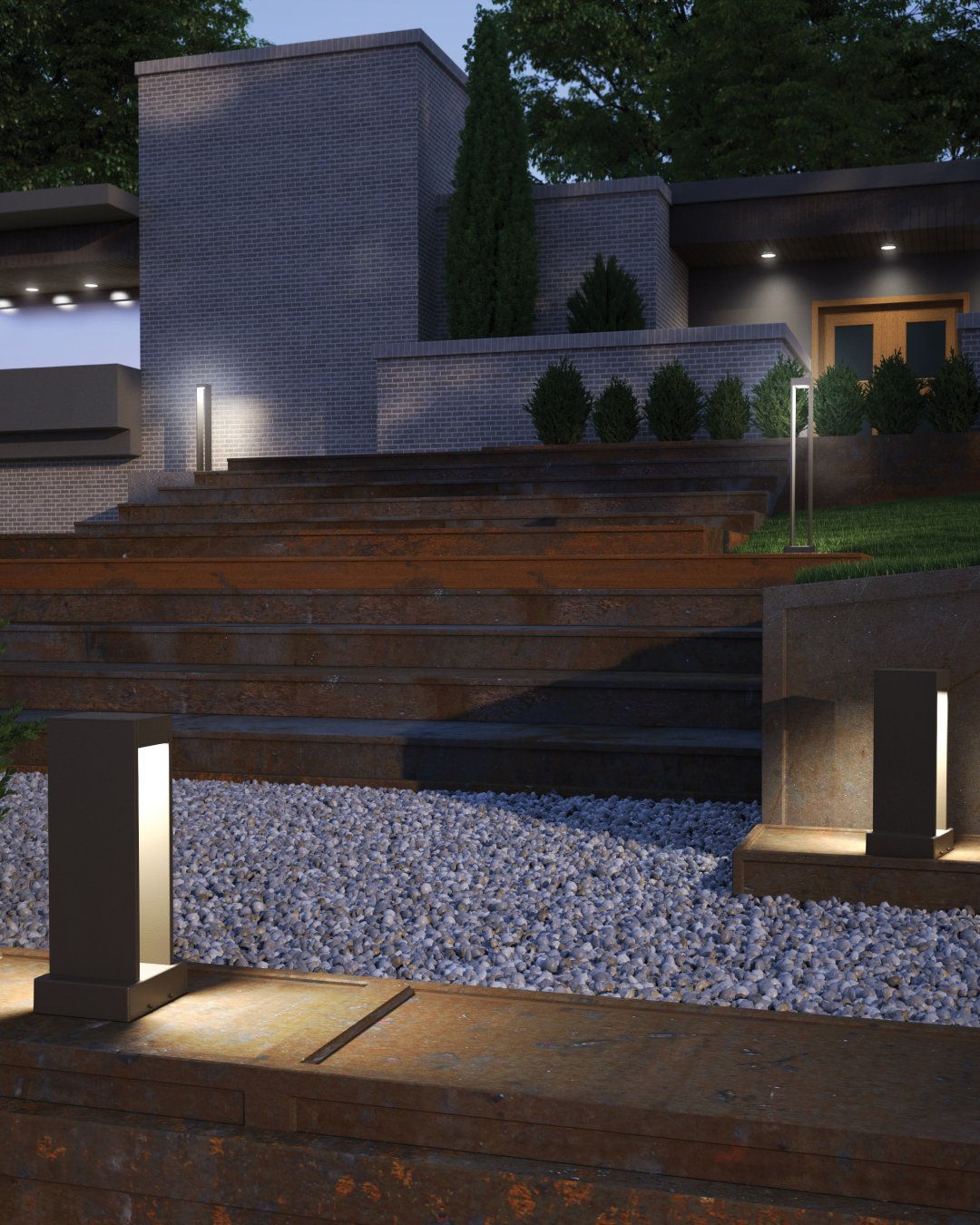
There are many categories of available exterior lighting fixtures that can be used in a variety of ways. In addition to the lamp post, pendant, ceiling fixture and wall sconce, other categories of outdoor lighting are becoming more popular, such as bollard lights (which are vertical posts, typically between 40” and 44” high and are used to increase visibility along architectural paths, steps or long driveways), path lights (which have a similar function to bollards, but they’re smaller in stature), and uplights (for highlighting greenery, water features or flagpoles).
Figure Out Your Outdoor Lighting Style
Do you want your outdoor lights to mimic the style of your indoor lighting in order to connect the two? Do you have a completely different architectural home exterior and want to accentuate that instead? Or, do you want to take the minimalist approach, so the fixtures almost disappear? Lighting styles, just like furniture and home accessories, are vast, from Modern and Art Deco to Cape Cod and French Provincial—and many more. The greatest exterior lighting development during recent years is that technology has advanced it to be just as decorative and varied as architectural lighting fixtures. So, you will definitely find something to achieve your desired outdoor lighting style.
Keep an Eye on Outdoor Lighting Ratings
It’s very important to make sure all the outdoor lighting you buy is wet-rated (which indicates the product can be used in areas directly exposed to rain) or damp-rated (for use in sheltered, but potentially damp environments). Also, be aware of what local code requirements may apply, such as Dark Sky compliance, which requires your architectural outdoor lighting to be directed downward to reduce light pollution into the night sky.
Increase the Value of Your Home with a Well-Lit, Outdoor Room
The number of people who believe their outdoor space is an important extension of their home is growing. In fact, according to Realtor magazine, the creation of an outdoor room is one of the biggest trends in home ownership in 2018. No longer made up of only a picnic table and small grill, an outdoor room is now defined as a multi-functional space that can handle food prep and cooking, is large enough for lounging and dining, and has a hearth product to extend the season. Creating these areas and designing enhanced light schemes around them can greatly increase the value of your home and give your family years of pleasure to come.
When you’re ready to execute your outdoor lighting strategy, check out the range of modern fixtures available from Tech Lighting. Need some more inspiration? Check out our Outdoor Lighting Ideas.
LED lighting is making a major impact on the cities of the world, whether it’s LED lighting in Nevada, or LED lighting in California, or even Tokyo, Japan. One big way that LED lighting is being highlighted in major cities is through architecture, with building designers making liberal use of LED lighting to feature their brand new buildings and bring them solidly into the 21st century.
In Los Angeles, California, the new tallest building in the state, the Wilshire Grand, had a lavish grand opening ceremony, which featured its 2,520 sq. ft. LED lighting display. The tallest building in the world, Dubai’s Burj Khalifa, is home to a 33,000 sq. ft. LED screen, which is routinely used to dazzle spectators with colorful displays, and to attract customers.
LED Streetlights Over the past few years, many American cities have been replacing their sodium vapor and fluorescent street lights with LED street lighting. A project initiated by the city of Las Vegas in 2013 is paying big dividends in the area of street light replacements. Beginning in that year, the city replaced more than 40,000 street lights with LED lamps, and at a cost of $18 million, the city expected to save $2 million per year in illumination costs, which would mean the project paid for itself within nine years.
In Los Angeles, city street lights were switched over to LED lighting, and the city had such an excess of power in utility plants that it could create 100 new car-charging stations for electric cars. In New York City, LED street lights were received well, because they reduced glare and excess light pollution for citizens of the city.
LED advertising For nearly the past 10 years, one of the biggest LED screens in the world has been situated at Harmon’s Retail Corner in Las Vegas, Nevada., and the screen is generally used to promote events and shows which are upcoming in the city. It has been very effective at notifying tourists as well as city residents about upcoming events, and it seems likely that other large LED screens positioned in major cities around the world will follow suit, and take advantage of the possibilities with LED advertising. The Wilshire Grand Center in Los Angeles, as well as the Burj Khalifa in Dubai will be excellent venues for advertising through massive LED screens that can reach thousands if not millions of people.
There is an ongoing debate among policy makers, international donors and researchers about how to provide energy access to poor rural areas. For many years, most funding was flowing into large-scale infrastructure projects to expand national electricity grids. However, grid extensions to remote and poor areas are expensive and difficult to maintain. At the same time, concerns about climate change combined with the decline in solar photovoltaic and battery prices have made solar-powered electricity an attractive investment.
Off-grid energy as key to fight poverty?
In particular, pico-solar products, such as small portable solar lights, have gained increased policy attention and international funding. Such products have low up-front costs, need little maintenance, and do not pose the management problems typically associated with national grids or even mini-grids. Solar photovoltaic charged products are hence seen as a possible solution to address both energy poverty and energy sustainability in the near future.Solar lanterns could replace kerosene lighting, which is still used by an estimated 500 million households. The emissions of kerosene lights contribute to global warming and to severe indoor air pollution. Moreover, kerosene lamps typically provide low-quality lighting, at around 10 lumens, while for example a standard LED lamp provides around 500 lumens. On the other hand, solar lanterns only provide minimal access to energy: they can’t power radios, TVs, fridges, or other appliances people may aspire to own as they become wealthier.
Whereas researchers agree that access to grid energy is important for economic growth, there is only scarce empirical evidence of the impact that off-grid energy access has on poverty. That’s why we conducted a policy field experiment in Kenya in collaboration with several policy partners. We analyzed the demand, use and effects of small portable solar lights, combining survey data with sensor data developed by the ETH spin-off Bonsai Systems.
Poor households spend a lot on little energy
At the start of our experiment, almost all 1,400 surveyed households used small kerosene (tin) lanterns with an open flame for lighting. A typical household spent 5–10% of its total cash expenditure on energy, mostly used for kerosene. In comparison, European households spend on average around 4% of their total expenditure on energy, but use more than five times more energy. We found a high demand for solar lanterns among poor rural households, but noticed that they responded very strongly to variations in cost. At the current market price of 9 US dollars, 29% households bought a light; if lights were sold at a subsidized price of 4 dollars, the demand more than doubled (69%).
Limited financial benefit…
A solar light typically replaces one of the households’ kerosene lanterns. As a result, households save around 2% of their overall monthly cash expenditure by spending less on kerosene. We found little evidence that access to better lighting improves children’s performance at school or increases adults’ working time. If only direct economic returns are considered, this would suggest that switching from kerosene to solar lighting might not always be cost-effective. However, this result might change if kerosene prices increase or photovoltaic prices further decrease.
…but positive impact on health and environment
Solar lanterns nevertheless reduced kerosene consumption by half and lead to a reduction in emissions, which helps in terms of climate change as well as indoor air pollution. We observed fewer symptoms of dry eye diseases and respiratory infections, which are often related to air pollution. Households might not take into account these positive environmental and health externalities when considering whether to buy a solar lantern and might hence underinvest in solar lanterns – a typical market failure.







 Bright Lighting